
About
- I currently work as a Research Engineer at EDF R&D, where I develop solutions based on tabular foundation models, Transformers for tabular and time series energy data and on Deep Learning for NILM (Non-Intrusive Load Monitoring), including training. My work focuses on feature engineering tabular foundation models, appliance detection and consumption signal reconstruction and load curve disaggregation. I also supervise internships on NILM, active learning and representation learning for time series and tabular foundation models.
- Since 2026, I have also been a trainer (Formatrice) at EDF R&D data and Aix-Marseille Université, teaching data science from linear models and decision trees to tabular foundation models, autoencoders, Transformers, transfer learning and in-context learning.
- Previously, I pursued a Ph.D. in applied mathematics at the CRIStAL laboratory within the SigMA team in Lille, France, and also at the MAP5 laboratory in the probability team in Paris, France. I successfully defended my thesis intitled titled “Point Processes for Numerical Integration” on the 27th of November 2023.
- In 2023-2024, I was a postdoctoral researcher at the LPSM laboratory, Sorbonne Université, working on change-point detection in Hawkes processes, and a researcher at Smovengo implementing an optimal transport and Deep Learning solution to optimize the morning redistribution of Vélib’ bikes.
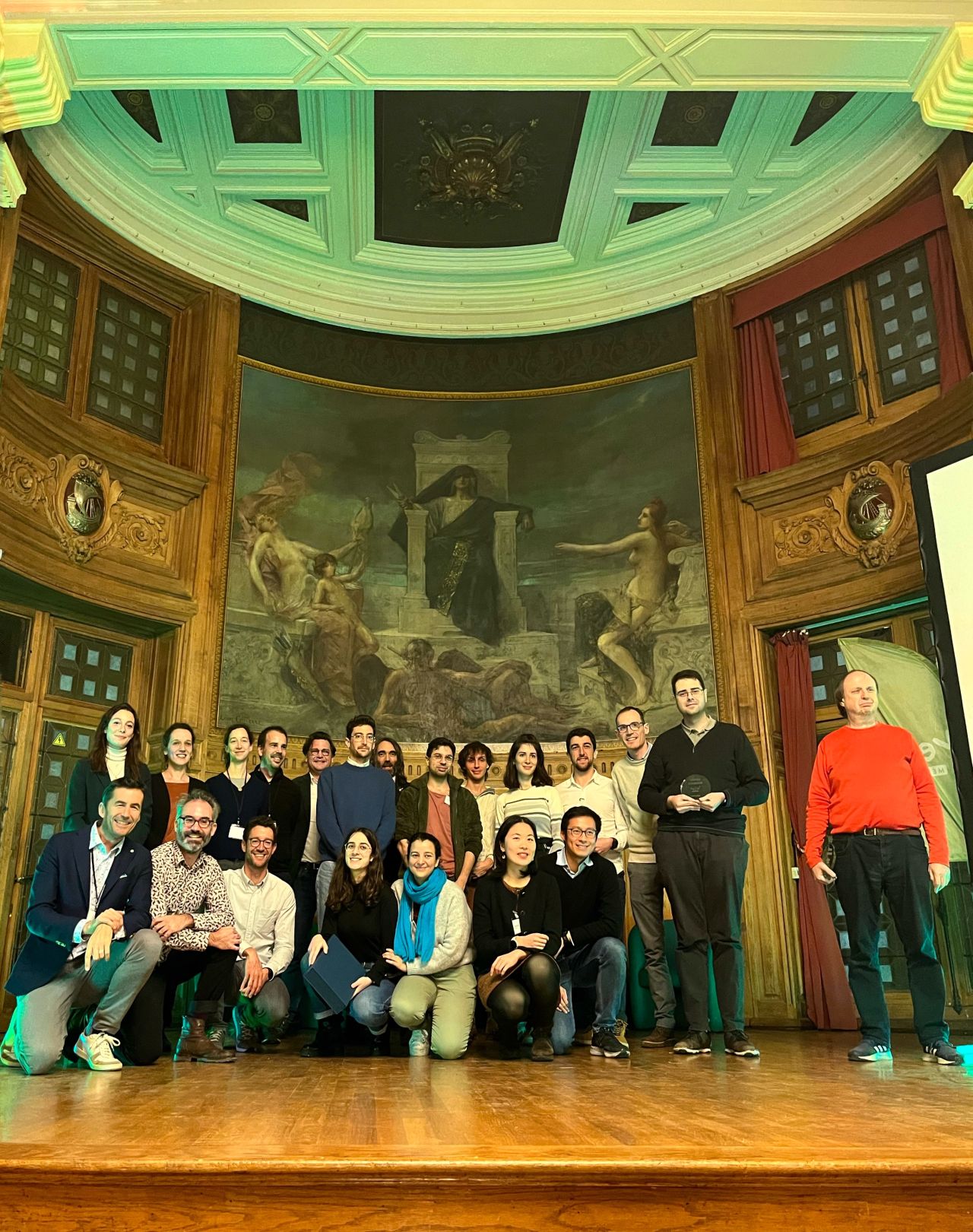
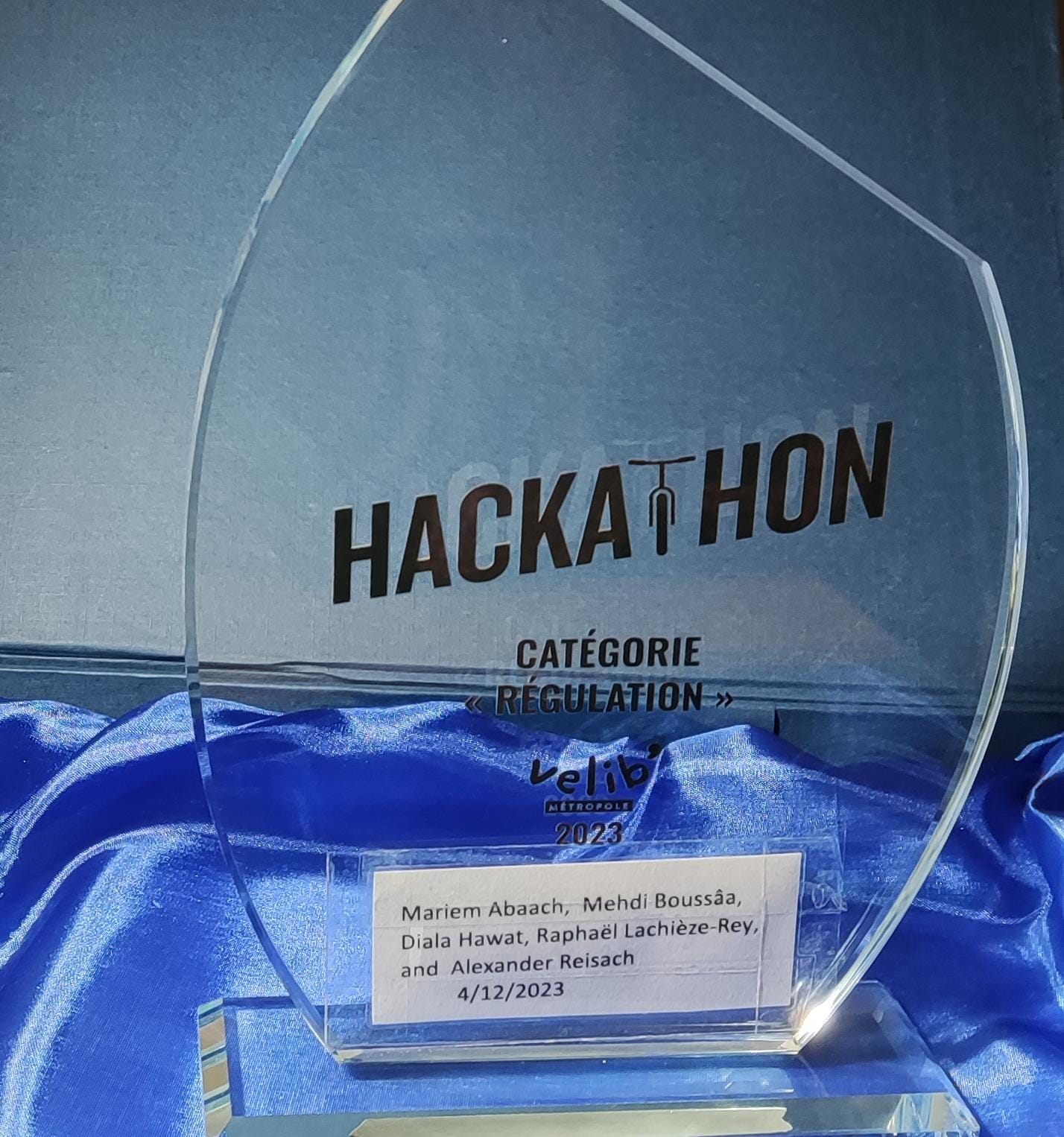
- In December 2023, my team secured first place in the “regulation” category at the hackathon Vélib’ métropole in Paris, France, focusing on improving the regulation of bikes at Vélib’s stations.
- Furthermore, in 2021, my team achieved victory in the challenge mathématiques et entreprise organized by AMIES. Our work revolved around enhancing data quality for Foyer, located in Leudelange, Luxembourg.
- Additionally, I received the PGSM excellence scholarship in 2019 for a Master 2 grant at Université Paris Cité, Paris, France.
News
-
Research Engineer at EDF R&D (2024-present):
I joined EDF R&D as a Research Engineer, working on tabular foundation models and Deep Learning for tabular for time series and tabular energy data.
-
Project (Dec 2023): Hackathon Vélib’ métropole
With Mariem Abaach, Mehdi Boussâa, Raphaël Lachièze-Rey, Alexander Reisach, and myself, our project won the Hackathon Vélib’ métropole in the “regulation” category. Our project focuses on improving the nightly regulation conducted by Smovengo, addressing imbalances in the fill levels of bike stations caused by users’ rides during the day. Following a data analysis, we identify a potential approach and mathematically reformulate the problem. We propose employing mathematical tools such as optimal transport and neural networks to numerically solve the issue. We aim to contribute towards the mitigation of this issue within this service we hold dear, and we are optimistic that pushing our project further may play a role in alleviating these challenges.
-
Ph.D. defense (Nov 2023):
I successfully defended my thesis intitled titled “Point Processes for Numerical Integration” on the 27th of November 2023.
-
Blogpost (Nov 2023):
`Coulomb rhymes with variance reduction… Well, it does rhyme if you read the title aloud with a French accent, hon hon hon.’‘
This marks the opening of a blog post authored by Rémi Bardenet. In the blog post, Rémi provides an engaging pedagogical summary of the main concept discussed in our recent preprint entitled ‘Repelled Point Processes with Application to Numerical Integration’, which was co-authored by my Ph.D. supervisors, Raphaêl Lachièze-Rey and Rémi Bardenet, along with myself. The complete blog post is available at [link] (https://statisfaction-blog.github.io/posts/01-11-2023-repelled-point-processes/repelled_point_processes.html).
Enjoy the read!
-
Python Package 2023:
MCRPPy :



An open-source Python package that currently includes:
* Methods for sampling from a variety of point processes, including the homogeneous Poisson, Thomas, Ginibre, scrambled Sobol, Binomial, and their Repelled counterparts.
* Several Monte Carlo methods, including a Monte Carlo method with the Repelled point process.
* Tools for visualizing the gravitational allocation from the Lebesgue measure to a point process within a two-dimensional space (d=2).
We provide three tutorial Jupyter Notebooks.
* Tutorial for sampling a Repelled point process.
* Tutorial for estimating function integrals using the available Monte Carlo methods.
* Tutorial for illustrating a two-dimensional gravitational allocation from Lebesgue to a point process.
We also provide two Jupyter Notebooks for replicating the study of the companion paper '’Repelled point processes with application to numerical integration’’.
Any feedback is most welcome!
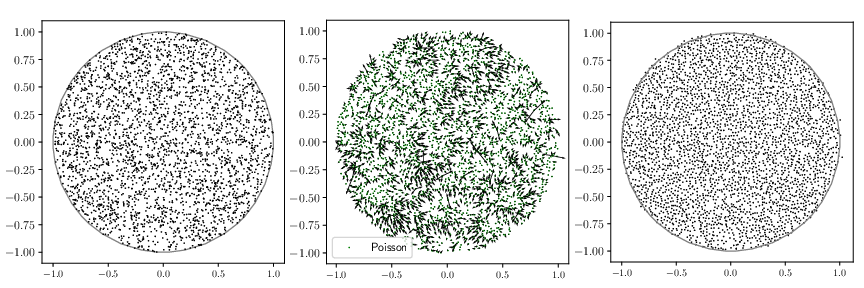
Figure: A sample from a Poisson point process (left) and the corresponding repelled point process (right). The force field driving the repulsion is represented in the middle.